
News and Interviews - Brazil
Artist from Moreira Sales is the third Brazilian to join the Imperial Academy of Arts of Russia
Publication dated September 25, 2025, in the news outlet Hora da Notícia from the TV broadcaster Cinturão Verde in the municipality of Cianorte - Paraná.
https://www.youtube.com/watch?v=6KTD7usm4uo
From Moreira Sales to the World!
Publication made on 09/25/2025 on the Instagram profile of the Municipal Government of Moreira Sales, in the municipality of Moreira Sales - Paraná.
Legal Professional Leaves Trusted Position at Federal Prosecutor's Office to Conquer the World of Fine Arts in Russia
Publication made on September 22, 2025, in the media outlet Agência de Comunicação - MoreiraNet, in the municipality of Moreira Sales - Paraná.
From Moreira Sales to Russia: Guilherme Silva swaps the robe for paintbrushes and shines in classical painting
Publication made on September 19, 2025, in the media outlet Tribuna da Região, in the municipality of Goioerê - Paraná.
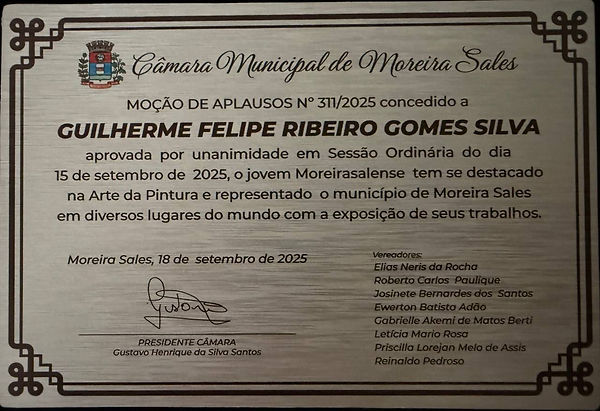
From Law to Canvases: Guilherme Gomes Silva Moved as He is Honored by the City Council
Publication made on September 18, 2025, in the media outlet Câmara Municipal de Moreira Sales, in the municipality of Moreira Sales - Paraná.

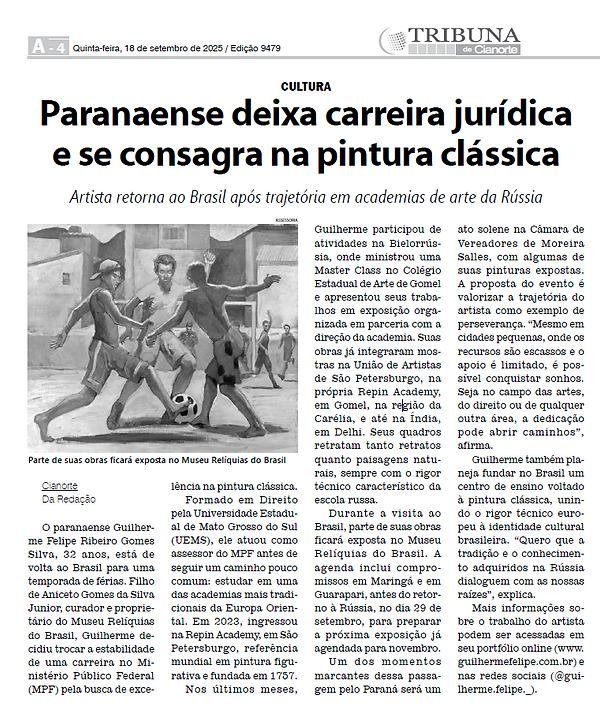
Paraná Native Leaves Legal Career Behind and Achieves Success in Classical Painting
Publication made on September 18, 2025, in the media outlet Tribuna de Cianorte, in the municipality of Cianorte - Paraná.
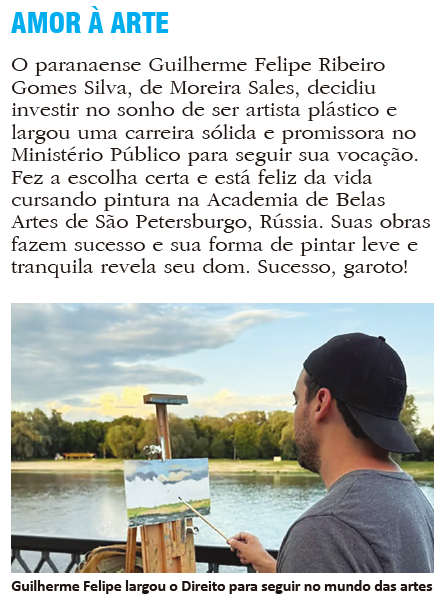
Love for Art
Publication made on September 17, 2025, in the media outlet Jornal do Povo, in the municipality of Maringá - Paraná.
Artist from Paraná Swaps Legal Career for Classical Painting in Russia
Publication made on September 9, 2025, in the media Gazeta Regional, in the municipality of Goioerê - Paraná.
News and Interviews - International
Temple - Datsan Gunzechoinei
Temple - Datsan Gunzechoinei
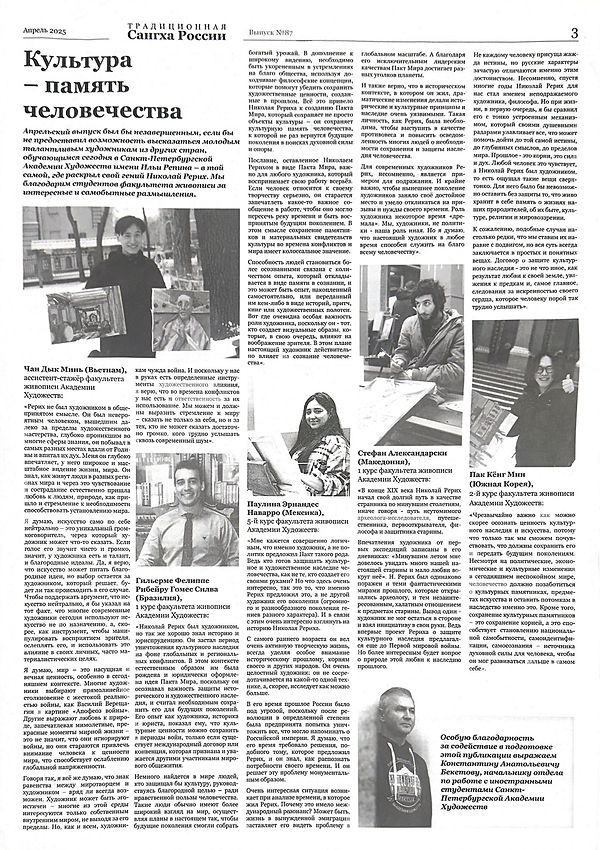
Culture – Humanity's Memory
The April 2025 issue of the newspaper "Traditional Sangha of Russia" would be incomplete without the testimonies of young artists from other countries currently studying at the St. Petersburg Academy of Art named after Ilya Repin. Students from the painting department shared their reflections on the legacy of Nikolai Roerich and the role of the artist in the contemporary world.
Beyond a broad vision, it is necessary to be rooted in an aspiration for the good of society, using accessible philosophical concepts that help convince others of the importance of preserving artistic values. All this led Nikolai Roerich to the creation of the Pax Cultura (Peace Pact), which preserves not only cultural objects—it preserves the cultural memory of humanity, which future generations turn to in search of spiritual strength and support. Established by Nikolai Roerich in the form of the Peace Pact, this landmark is important for any artist who takes their work seriously. The preservation of monuments and material testimonies of culture in times of both conflict and peace holds enormous significance.
Stefan Alexandarski (Macedonia), 1st-year painting student, notes: "In the late 19th century, Nikolai Roerich began his long journey as a tireless painter, traveler, explorer, philosopher, and protector of antiquity. His impressions from early expeditions show a deep love for his country's legacy. For him, it was impossible to leave unprotected what holds within it the memory of our ancestors' lives. The treaty for the protection of cultural heritage is the result of love for one's own land, respect for ancestors, and the pursuit of sincerity in one's own heart."
Park Kyung Min (South Korea), 2nd-year painting student, emphasizes: "It is extremely important to perceive the value of cultural heritage and art because only then can we feel that we must preserve it and pass it on to future generations. The preservation of cultural monuments is the preservation of roots, which contributes to the formation of national identity, the self-identification of a nation, and serves as a source of spiritual strength for humans."
Tran Duc Minh (Vietnam), assistant-intern in the painting course, believes: "Roerich was not an artist in the conventional sense. He was an incredible man who went far beyond artistic mastery. Art itself is neutral—it is a unique tool. If an artist's voice sounds pure and loud, it means they possess both talent and noble ideals. We can and must express the yearning for peace—to speak not only for ourselves but for those who are difficult to hear."
Guilherme Felipe Ribeiro Gomes Silva (Brazil), 1st-year painting student, adds: "Nikolai Roerich, who knew history well, was aware of the importance of protecting our legacy. His experience showed that cultural values can only be preserved during wartime if an international treaty exists. People like Roerich face difficulties, but their perseverance inspires us to reflect on the profound meaning of our creation and our responsibility. Art is a bridge between the past and the future."
Anna Petrova (Russia), 3rd-year painting student, says: "Roerich's legacy is an example of the synthesis of arts and philosophy. His paintings are philosophical treatises written in ink. In our time, art must unite people, reminding them of common roots. The Peace Pact is the practical embodiment of the idea that culture is a heritage of all humanity."
Li Zheng (China), 2nd-year printmaking student, observes: "Roerich combined the soul of an artist with the will of a social activist. His example shows that we can be active participants in society's life. Our art can be a tool for enlightenment, for defending peace and cultural heritage, especially in the age of informational noise."
Maria Ivanova (Russia), postgraduate student in Art History, summarizes: "It is difficult to overestimate Roerich's contribution to world culture. His Pact established the ethical foundation for the relationship with heritage. Contemporary artists should look to Roerich's legacy as a handbook of civic responsibility."
The editorial board expresses its special gratitude to Konstantin Anatolievich Evgeniev, Head of the Department for Work with International Students at the St. Petersburg Academy of Arts, for his support in preparing this publication.
The theme of culture as humanity's memory, raised by Nikolai Roerich, remains relevant, and it is gratifying to see that young artists from different parts of the world are aware of their role in its preservation and enrichment.
Monastery - Karelia (Карелия) - Syandeba (Сяндеба)
Sou um parágrafo. Clique aqui para adicionar e editar seu próprio texto. É fácil.
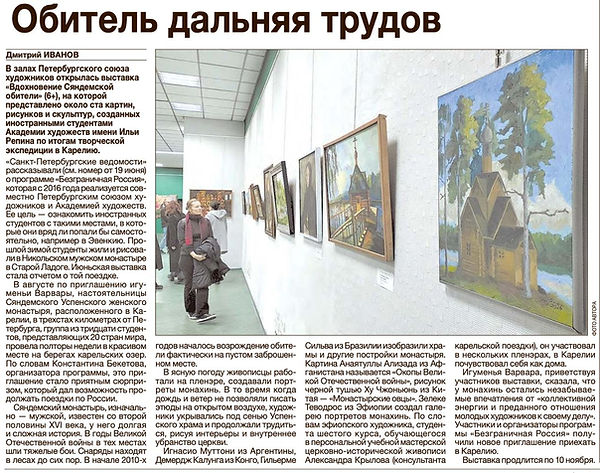
A Remote Refuge for Work
By Dmitry IVANOV
In the halls of the St. Petersburg Artists' Union, the exhibition "Inspiration from the Sandemsky Refuge" (6+) has opened, featuring around one hundred paintings, drawings, and sculptures created by international students of the Ilya Repin Academy of Arts as a result of a creative expedition to Karelia.
St. Petersburg Vedomosti reported (see the June 19 issue) on the "Unlimited Russia" program, which has been jointly conducted since 2016 by the St. Petersburg Artists' Union and the Academy of Arts. Its aim is to familiarize international students with places they would hardly visit on their own, such as Karelia. Last winter, the students lived and painted at the St. Nicholas Monastery in Staraya Ladoga. The current exhibition is the report of their summer trip.
In August, at the invitation of Mother Superior Varvara, the abbess of the Dormition Sandemsky Convent located in Karelia, three hundred kilometers from St. Petersburg, a group of thirty students, representing 20 countries, spent a week and a half in a beautiful location on the shores of Karelia's lakes. According to Konstantin Beketov, the program's organizer, this invitation was a pleasant surprise that allowed them to continue their travels across Russia.
The Sandemsky Monastery, originally a male monastery, has been known since the second half of the 16th century and has a long and complex history. During the years of the Great Patriotic War, heavy battles took place in that region. Artillery shells are still found in the forests today. In the early 2010s, the revival of the monastery began, practically in an abandoned and empty location.
In good weather, the artists worked outdoors (plein air), creating portraits of the nuns. When rain and wind made outdoor sketching impossible, the artists gathered under the shelter of the Dormition Church and continued their work, drawing the interiors and the inner contents of the church.
Ignacio Muttoni from Argentina, Demerge Kalunga from Congo, and Guilherme Silva from Brazil depicted the temples and other structures of the monastery. The painting by Atroulla Alizada from Afghanistan is titled "Trenches of the Great Patriotic War," and the black ink drawing by Hu Jongyon from China is called "Monastery Sheep." Zelené Tewodros from Ethiopia created a gallery of portraits of the nuns. According to the Ethiopian artist, a sixth-year student studying in the personal educational studio of historical church painting under Alexander Krylov (consultant for the Karelia trip), he participated in several plein air sessions and felt at home in Karelia.
Mother Superior Varvara, while greeting the exhibition participants, said that the nuns retained unforgettable impressions of the "collective energy and the dedicated attitude of the young artists towards their work." The participants and organizers of the "Unlimited Russia" program received a new invitation to visit Karelia.
The exhibition will be open until November 10th.
